
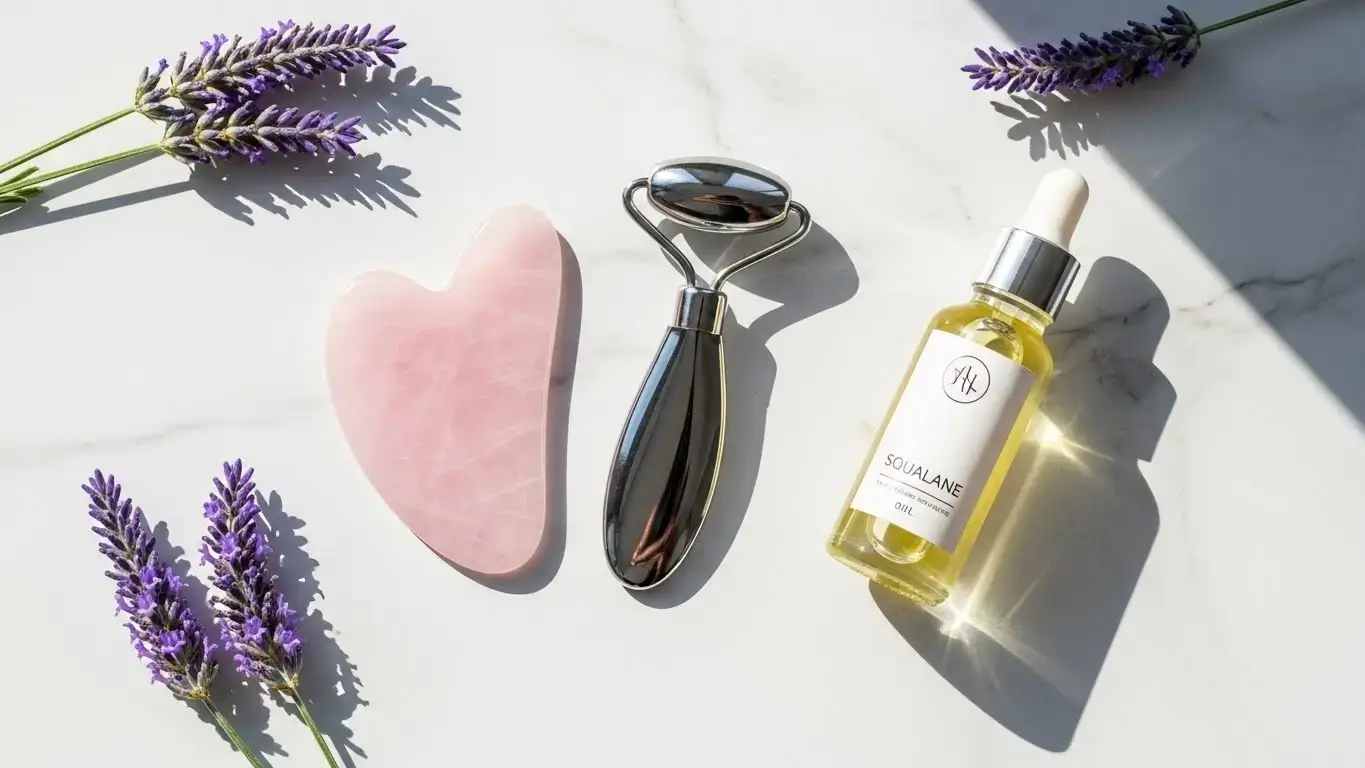
Worried about redness? Discover the best gua sha tools for beginners with sensitive skin in 2025. We review soothing Rose Quartz options and share expert techniques for a glow without irritation.
Let’s be honest: seeing those viral videos of people aggressively scraping their faces until they turn bright red can be terrifying—especially if you have sensitive skin. If just looking at a new skincare product makes your face flush, the idea of rubbing a stone on it might seem counterintuitive.
But here is the secret that estheticians know: Gua Sha, when done correctly, is actually one of the most soothing therapies for reactive skin. It’s not about force; it’s about flow.
For beginners with sensitive skin, the barrier to entry isn’t skill—it’s choosing the right tool and mastering the “feather-light” touch. In this deep dive, we are going to bypass the hard jade stones and textured rollers. Instead, we will focus on the best gua sha tools for beginners with sensitive skin that prioritize cooling, calming, and lymphatic drainage over deep tissue work. Ready to get that glow without the flare-up? Let’s dive in.
Table of Contents
- 1. Ancient Roots, Modern Glow: Why Gua Sha Works for Sensitivity
- 2. Material Matters: Why Rose Quartz Beats Jade for Beginners
- 3. Review: Top 5 Best Gua Sha Tools for Beginners with Sensitive Skin
- 4. Step-by-Step: The “No-Redness” Facial Massage Routine
- 5. Crucial Tips: Oils, Safety, and Avoiding Irritation
- 6. FAQ: Common Questions from Beginners
Ancient Roots, Modern Glow: Why Gua Sha Works for Sensitivity
Gua Sha (pronounced gwah-shah) is a healing modality from Traditional Chinese Medicine (TCM) that dates back thousands of years. Historically, it was used on the body with vigorous pressure to scrape away illness and stagnation (energy blocks). However, the facial gua sha we practice today is a much gentler evolution.
For sensitive skin types, the primary benefit isn’t “scraping”—it’s drainage. Sensitive skin often correlates with inflammation and heat. A gentle gua sha practice helps to:
- Reduce Puffiness: By moving stagnant lymph fluid, we reduce the pressure on capillaries.
- Cool the Skin: Using materials like Rose Quartz or Stainless Steel physically draws heat out of inflamed areas.
- Calm the Nervous System: Slow, rhythmic movements shift your body from “fight or flight” (sympathetic) to “rest and digest” (parasympathetic), which can actually lower skin reactivity.
Material Matters: Why Rose Quartz Beats Jade for Beginners
When searching for the best gua sha tools for beginners with sensitive skin, the material is just as important as the shape. While Jade is the traditional choice, it isn’t always the best for reactive skin.
Why Rose Quartz?
Rose Quartz is denser than Jade, meaning it holds a cool temperature for longer. For someone prone to rosacea or heat-based redness, a cold stone acts like a cryotherapy session, constricting blood vessels and soothing flare-ups immediately.
The Rise of Stainless Steel
Recently, stainless steel tools have become a favorite for acne-prone sensitive skin. Why? Because they are non-porous. Natural stones can develop microscopic cracks that harbor bacteria. Stainless steel is 100% hygienic, colder than stone, and unbreakable—perfect for clumsy beginners.
Review: Top 5 Best Gua Sha Tools for Beginners with Sensitive Skin
We’ve tested dozens of tools to find the ones that are easy to hold, have smooth edges (crucial!), and provide the most soothing experience.
1. The Classic Heart: Natural Rose Quartz Gua Sha Board
Best For: The absolute beginner wanting an all-rounder.
This is the shape you see everywhere, and for good reason. The “heart” divot fits perfectly along the jawline, while the long side is ideal for the neck. Rose Quartz is naturally cooling, making it the top pick for calming redness.
Pro Tip: Look for a stone that is thicker (at least 5mm). Thinner stones can feel “sharp” on sensitive skin.

2. The Hygienic Hero: Stainless Steel Gua Sha Tool
Best For: Acne-prone sensitive skin & barrier repair.
If your sensitivity comes with breakouts, skip the stone and grab steel. It’s self-cooling (ice cold!) and non-porous, meaning you won’t spread bacteria. It glides effortlessly and provides excellent feedback so you don’t push too hard.
3. The Gentle Glider: Green Aventurine Spoon
Best For: Delicate eyes and pinpoint tension.
Instead of a flat board, a “spoon” shape offers a rounded, soft surface. This is incredible for beginners who are afraid of dragging their skin. You can use the rounded back to gently massage temples and sinuses without any scraping motion.
4. The “Wave” Shape: White Jade Smoothing Tool
Best For: Larger surface areas (Cheeks/Forehead).
White Jade is known in TCM for its balancing properties. The wave shape usually lacks the sharp points of the heart shape, making it safer for those who might accidentally poke themselves. It covers more surface area, reducing the number of passes needed.
5. The Vibrating Wand: Electric Rose Quartz Gua Sha
Best For: Those who want technology + tradition.
For sensitive skin that needs stimulation without friction, an electric tool that combines heat (optional) and vibration can be magic. You barely need to move the tool; the vibration does the work to stimulate lymph flow.
Step-by-Step: The “No-Redness” Facial Massage Routine
Using the best gua sha tools for beginners with sensitive skin is useless if your technique is aggressive. For us sensitive folks, the rule is: Feather-Light Pressure.
⚠️ The Angle Rule: Never hold the tool perpendicular (90 degrees) to your skin. Lay it almost flat (15 degrees). This maximizes surface contact and minimizes dragging.
- Open the Neck: Start at the base of your neck. Gently glide the tool up towards the base of the skull (back) and down the sides of the neck to drain lymph. Repeat 3-5 times.
- Jawline Definition: Place the “heart” notch of your tool on your chin. Glide along the jawline towards the earlobe. Wiggle gently at the end to release tension.
- Cheek Lift: Use the long, curved side. Start at the nose and glide out towards the ear. Do NOT dig in. Imagine you are just moving the skin’s surface.
- Under Eye Soothing: Use the flattest part of the tool. Start inner corner, glide to temple. Use zero pressure here—just the weight of the stone.
- Forehead Smooth: Start at the brows and glide up to the hairline. This helps lift the eyes and calm the nervous system.
Crucial Tips: Oils, Safety, and Avoiding Irritation
There is a dangerous myth floating around that you can do Gua Sha on dry skin. Please, do not do this. Especially if you have sensitive skin, dry scraping will cause “sha” (red marks/bruising) and broken capillaries.
The “No-Oil” Alternative
If you hate facial oils or they clog your pores, you cannot skip the slip, but you can change the medium. Try these alternatives:
- The Sheet Mask Hack: Apply a hydrating sheet mask and perform Gua Sha over the mask. The serum provides incredible slip, and the fabric protects your skin barrier from direct friction.
- Thick Moisturizer or Balm: Mix your moisturizer with a drop of squalane (very skin-safe) to create a buffer.
Temperature Control
Keep your Rose Quartz or Stainless Steel tool in the fridge for 10 minutes before use. The cold constricts capillaries, preventing the redness that usually comes with friction.
Ready to Start Your Gua Sha Routine? ✨
Join our calm-skin community! Sign up for our weekly newsletter to get a FREE 7-Day Sensitive Skin Gua Sha Guide delivered to your inbox.Get My Free Guide
FAQ: Common Questions from Beginners ❓
Does Gua Sha hurt sensitive skin?
It absolutely should not hurt. If it hurts, you are using too much pressure. The goal is lymphatic drainage, and lymph vessels sit just below the skin surface. A feather-light touch is all you need.
Can Gua Sha cause acne or breakouts?
It can if you use a porous stone (like cheap jade) that harbors bacteria, or if you stimulate the skin too aggressively. Using a Stainless Steel tool and cleaning it with soap and water after every use minimizes this risk.
How often should I do facial Gua Sha?
For sensitive skin, less is more. Start with 1-2 times a week. Monitor how your skin reacts. If there is no irritation, you can build up to 3 times a week, but daily use might be too stimulating for some.
Which oil is safe for sensitive skin Gua Sha?
Squalane oil, Jojoba oil, and Rosehip oil are excellent choices. They are non-comedogenic (won’t clog pores) and mimic the skin’s natural sebum, reducing the risk of a reaction.
Disclaimer: This article is for informational purposes only and does not substitute for professional medical advice. Always consult with a dermatologist before starting a new skincare routine, especially if you have active skin conditions.