
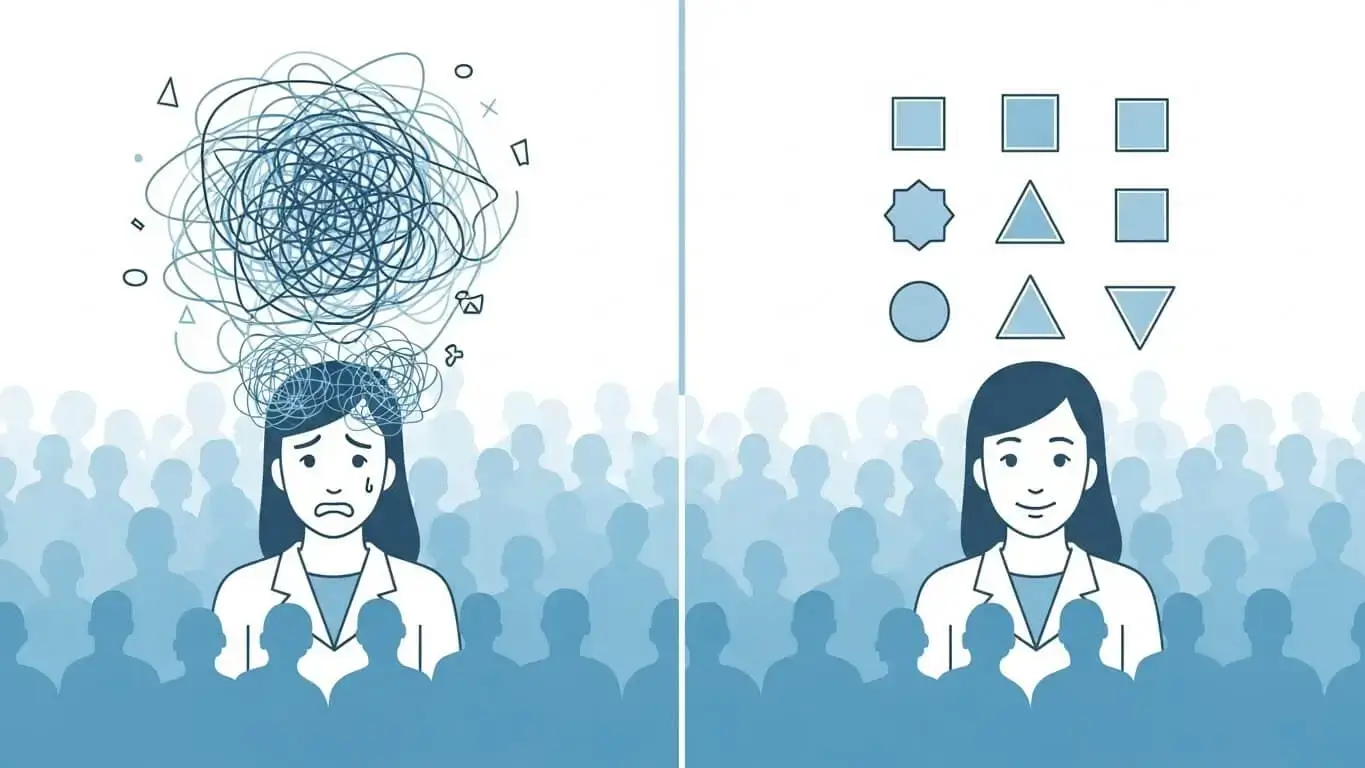
Effective CBT strategies to overcome social anxiety—practical tips for adults in everyday situations. This step-by-step guide offers expert insights, exposure hierarchy templates, and cognitive restructuring exercises to help you reclaim your confidence.
Have you ever walked into a crowded room and felt an immediate, crushing weight on your chest? Or perhaps you’ve replayed a 30-second conversation in your head for three days straight, convinced you said something “stupid.”

If you nodded along, let me tell you: you are not alone, and you are not broken. Social anxiety disorder affects millions of adults, turning everyday interactions into high-stakes performances. But here is the good news: the brain is plastic. It can be rewired.
Cognitive Behavioral Therapy (CBT) is widely considered the gold standard for treating social anxiety. It doesn’t just put a bandage on the fear; it dismantles the machinery that creates it. In this guide, we aren’t just listing theories. We are going to walk through actionable CBT techniques for social anxiety in adults that you can start practicing today. Let’s get your life back. 😊
📑 Table of Contents
- What is CBT and Why Does it Work for Anxiety?
- Technique 1: Cognitive Restructuring (The Detective Work)
- Technique 2: Behavioral Experiments & Exposure
- Technique 3: Mindfulness and Attention Training
- Step-by-Step Worksheet Guide
- Frequently Asked Questions
What is CBT and Why Does it Work? 🤔
Cognitive Behavioral Therapy (CBT) operates on a simple but profound triangle: Thoughts, Feelings, and Behaviors. In the context of social anxiety, this cycle often looks like a trap.
When you have social anxiety, your brain has a “false alarm” system. It perceives a safe social gathering as a threat, similar to encountering a bear in the woods. CBT intervenes by slowing down this process.
💡 The Core Concept
It is not the situation (e.g., the party) that causes your anxiety; it is your interpretation of the situation (e.g., “Everyone will see I’m awkward”). Change the interpretation, and you change the emotional response.
Technique 1: Cognitive Restructuring (The Detective Work) 🕵️♀️
Cognitive Restructuring is the process of identifying and challenging Automatic Negative Thoughts (ANTs). These are the thoughts that pop into your head instantly before or during a social event.
Identify the Distortion
Social anxiety usually feeds on specific cognitive distortions. Do any of these sound familiar?
- Mind Reading: “She looked at her phone while I was talking; she must think I’m boring.”
- Catastrophizing: “If I stumble over my words, everyone will laugh and I’ll be ruined.”
- Spotlight Effect: “Everyone is noticing my trembling hands.”
Challenge the Thought
Once you catch a thought, put it on trial. Ask yourself: “What is the evidence for this thought? What is the evidence against it?”
| 🚫 Anxious Thought (ANT) | ✅ Balanced Alternative |
|---|---|
| “I didn’t say much at dinner. They think I’m weird.” | “I was quiet, but I was listening. Being a good listener is a social skill, not a flaw.” |
| “My voice shook. Everyone saw I was nervous.” | “Even if my voice shook, people likely didn’t notice or didn’t care. Anxiety is a normal human emotion.” |
| “I have to be funny or they won’t like me.” | “My friends like me for who I am, not for a performance. It’s okay to just ‘be’.” |
Technique 2: Behavioral Experiments & Exposure 📉
This is arguably the most powerful part of CBT. Avoidance fuels anxiety. Every time you cancel plans or avoid eye contact, your brain sighs in relief and “learns” that avoidance saved you. To break this, we use Exposure Therapy.
⚠️ Warning: Don’t Flood Yourself!
Do not jump into your biggest fear (e.g., public speaking to 100 people) on day one. This can backfire. We use a “Fear Hierarchy” to take baby steps.
Building Your Fear Hierarchy (The Ladder)
Rate situations on a scale of 0-100 (SUDS – Subjective Units of Distress Scale). Start with something that is a 30 or 40.
📋 Example Hierarchy for Someone Fearful of Judgment
- Step 1 (Distress 30/100): Ask a stranger for the time or directions.
- Step 2 (Distress 50/100): Make eye contact and smile at a cashier.
- Step 3 (Distress 70/100): Intentionally make a small mistake (e.g., drop a pen) in public and don’t apologize excessively.
- Step 4 (Distress 90/100): Ask a question in a group meeting.
The Goal: Stay in the situation until your anxiety drops by at least half. You are teaching your amygdala (the brain’s fear center) that nothing bad happened.
Technique 3: Mindfulness and Attention Training 🧘♂️
Socially anxious adults tend to have an internal focus of attention. In a conversation, instead of listening to the other person, you might be monitoring your own heart rate, checking if your hands are sweating, or planning your next sentence.
CBT encourages shifting focus externally. This isn’t just “ignoring” the anxiety; it’s actively engaging with the world.
Try the “5-4-3-2-1” Grounding Technique
Before a social event, stop and identify:
- 5 things you can see (texture of the wall, color of someone’s shirt).
- 4 things you can feel (feet on the floor, fabric of your jeans).
- 3 things you can hear (traffic, AC humming).
- 2 things you can smell.
- 1 thing you can taste.
This forces your brain out of the “future-worry” mode and into the present moment.
Step-by-Step Worksheet Guide: Putting It All Together 📚
You can’t learn to swim by reading a book, and you can’t cure social anxiety just by reading this blog post. You need to do the work. Here is a simple structure for your daily practice.
The A.B.C. Worksheet Model
Create a note on your phone or use a journal with these three columns:
- A – Activating Event: Briefly describe the situation.
Example: “Going to the office holiday party.” - B – Beliefs (Thoughts): What went through your mind? Rate your belief in them (0-100%).
Example: “I won’t have anyone to talk to (90%). I will look like a loner (100%).” - C – Consequences (Feelings/Behaviors): How did you feel? What did you do?
Example: “Anxious, sweaty palms. I stood in the corner on my phone.” - D – Dispute (The Intervention): Challenge column B.
Example: “I know Sarah from accounting, I can talk to her. Even if I stand alone for 5 minutes, it doesn’t mean I’m a loner, it just means I’m taking a break.”
By consistently writing these down, you move the anxiety from the emotional part of your brain to the analytical part (the prefrontal cortex), which naturally reduces the intensity of the fear.
Final Thoughts: Be Patient with Yourself 📝
Overcoming social anxiety is not a linear journey. There will be days when the “Core Beliefs” feel stronger than your new rational thoughts. That is okay. CBT is a muscle; the more you exercise it, the stronger it gets.
Start with one small behavioral experiment this week. Maybe it’s just smiling at a neighbor or keeping your camera on during a Zoom call. You are capable of handling the discomfort, and on the other side of that discomfort is the connection and freedom you deserve.
Got a specific situation you are dreading? Drop it in the comments below, and let’s brainstorm a “balanced thought” for it together! You’ve got this. 😊

Frequently Asked Questions ❓
Q: How long does it take for CBT to work for social anxiety?
A: While individual results vary, many adults start seeing significant improvements within 12 to 16 weeks of consistent practice. The key is regular engagement with the exercises, particularly the behavioral experiments.
Q: Can I do CBT on my own without a therapist?
A: Yes, self-directed CBT can be very effective, especially for mild to moderate social anxiety. Using worksheets, apps, and guided books helps. However, for severe anxiety or trauma-related issues, working with a licensed therapist is recommended to guide you through exposure exercises safely.
Q: Is CBT better than medication for social anxiety?
A: Research often suggests that CBT has more durable long-term results than medication alone because it teaches you skills to manage anxiety for life. However, a combination of medication (to manage symptoms) and CBT (to change patterns) is often the most effective treatment plan for many adults.
Q: What if my exposure experiment goes badly?
A: This is actually a valuable learning opportunity! In CBT, a “bad” outcome (e.g., you stumble over words) is used to test your resilience. You’ll likely realize that even though the awkward thing happened, the catastrophe you feared (e.g., being shunned forever) did not. Surviving the “worst-case scenario” builds immense confidence.