
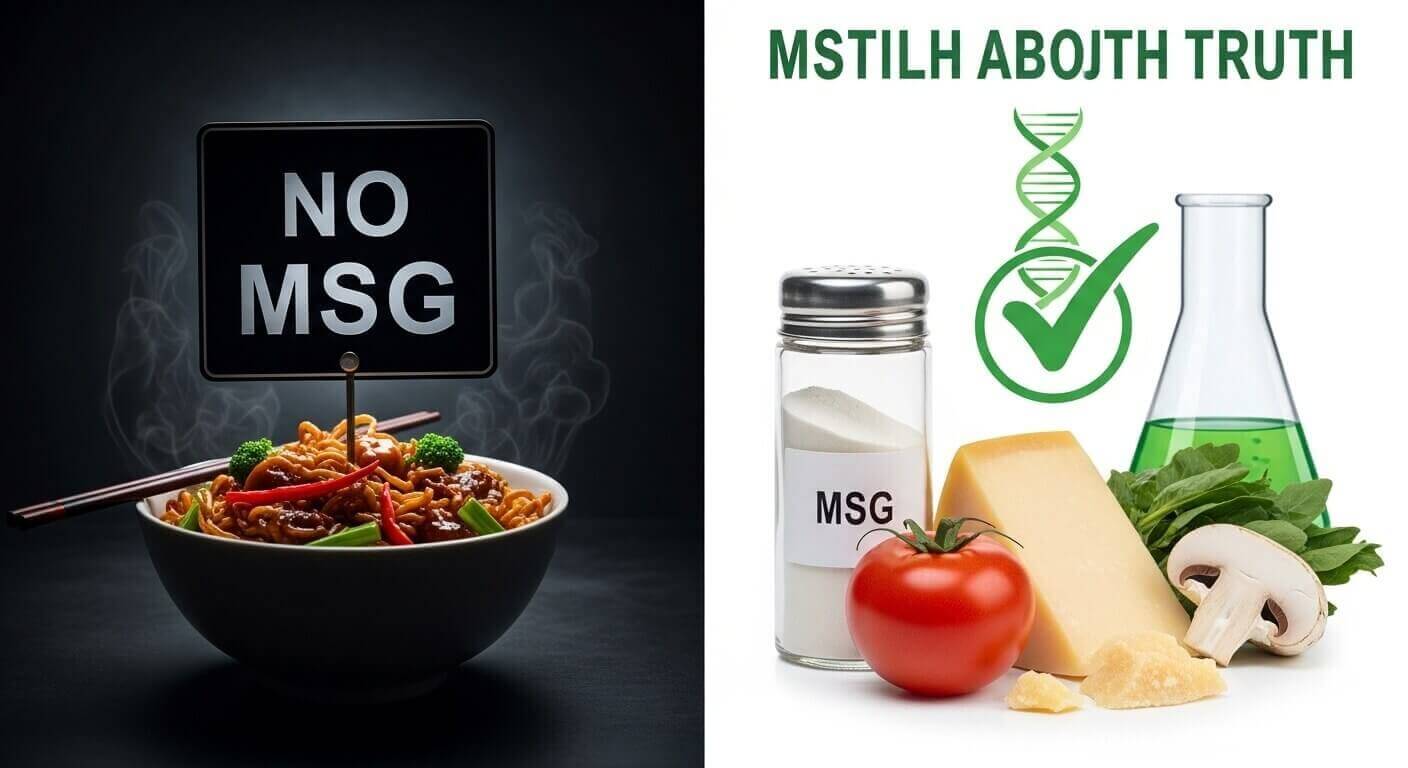
The 50-Year-Old Lie About MSG: For decades, the “magic powder” MSG has been blamed for headaches, flushing, and more. But what if this entire narrative was built on a lie? Discover the scientific truth about ‘Chinese Restaurant Syndrome’ and why the world’s top health organizations confirm MSG is safe—and perhaps, even beneficial.
We’ve all seen it. That bold, reassuring print on a snack bag or restaurant menu: “No MSG.” For 50 years, this simple three-letter acronym has been treated like a culinary villain, a “magic powder” responsible for everything from splitting headaches and flushing skin to heart palpitations and general malaise. We’ve been taught to fear it, to avoid it, and to blame it for feeling unwell after a big meal.

But what if that entire story—that 50-year-old lie—was built on a foundation of shaky anecdotes, xenophobia, and a profound misunderstanding of science? What if the very organizations we trust to protect our health, like the FDA and the World Health Organization (WHO), have been saying it’s safe all along?
Today, we’re not just debunking a myth; we’re dismantling it. As someone who trusts in data, I’ve dug into the decades of research, the flawed studies, and the authoritative reports. We’ll explore the real origins of this lie, what MSG *actually* is, and what’s *really* making you feel sluggish after that takeout. The answer might just change the way you look at your pantry. 😊
Table of Contents
- The Birth of a 50-Year Lie: The “Chinese Restaurant Syndrome” Myth
- Is MSG Harmful? What the World’s Top Health Experts Say
- What is MSG, Anyway? The Science of Glutamate and Umami
- The Real Culprit: Why You Feel Bad After Eating (It’s Not the MSG Lie)
- The Surprising Truth: How MSG Can *Reduce* Your Sodium Intake
- Conclusion: Debunking the 50-Year MSG Lie for Good
- Frequently Asked Questions (FAQ) About MSG
The Birth of a 50-Year Lie: The “Chinese Restaurant Syndrome” Myth 🤔
The entire MSG lie can be traced back to a single letter. In 1968, a physician named Dr. Robert Ho Man Kwok wrote a letter to the *New England Journal of Medicine*. He described feeling symptoms like numbness at the back of his neck, weakness, and heart palpitations after eating at Chinese-American restaurants. He speculated about several possible causes, including soy sauce, high sodium, or… Monosodium Glutamate.
The journal published his letter under the editor-given title, “Chinese Restaurant Syndrome.” The name stuck, and it opened the floodgates. Suddenly, people everywhere began attributing any discomfort after a meal to MSG. Other doctors sent in letters describing completely different symptoms—some fainted, some had back spasms, others just felt dizzy. There was zero consistency.
This is a crucial point: the conclusion that MSG was harmful became popular *before* any rigorous science was done. It was a social phenomenon, a classic case of confirmation bias, fueled by a name with clear xenophobic and racist undertones. The public had its villain. It would take scientists decades to undo the damage. The term was eventually renamed the “MSG Symptom Complex” to be more neutral, but the lie was already firmly rooted.
Is MSG Harmful? What the World’s Top Health Experts Say 👩⚕️
When you bypass the anecdotes and look at the actual scientific evidence, the story completely flips. For decades, every major international health and food safety organization has investigated MSG and reached the same conclusion.
The FDA’s Official Stance on MSG
The U.S. Food and Drug Administration (FDA) includes MSG in its “Generally Recognized As Safe” (GRAS) category. This isn’t a passive designation. In the 1990s, the FDA commissioned a massive independent report from the Federation of American Societies for Experimental Biology (FASEB) to settle the issue.
Their findings? MSG is safe for the general population when consumed at normal levels. The *only* potential (and unproven) effect they noted was for a tiny subset of self-described “sensitive” people who consumed 3 grams or more of pure MSG on a completely empty stomach. To put that in perspective, a typical serving of food with added MSG contains less than 0.5 grams. This “danger” scenario is completely unrealistic.
The Global Consensus: From the WHO to the EU
This isn’t just an American conclusion. The global consensus is even stronger:
- The World Health Organization (WHO) & FAO (JECFA): The Joint FAO/WHO Expert Committee on Food Additives places MSG in its safest possible category: “ADI not specified.” This designation means that, based on overwhelming scientific data, there is no need to set a “safe” upper limit for daily consumption.
- European Union (EU): The European Food Safety Authority (EFSA) has also confirmed its safety and authorized it as a food additive.
- Other Authorities: Food Standards Australia New Zealand (FSANZ), the American Medical Association (AMA), and scientific bodies worldwide all concur.
The scientific community is not divided on this. The 50-year-old lie is just that—a lie.
What is MSG, Anyway? The Science of Glutamate and Umami 🍅
Part of the fear comes from its chemical-sounding name. “Monosodium Glutamate.” It sounds artificial and scary. But here’s what it actually is: MSG is just the sodium salt of glutamic acid.
Glutamic acid is one of the most common and abundant amino acids found in nature. It’s a non-essential amino acid, meaning our own bodies produce it. It’s also a fundamental building block of protein. It is, quite simply, the source of the fifth taste: umami (a savory, rich, “meaty” flavor).
Your Body Can’t Tell the Difference (The Glutamate Myth)
This is the most important scientific fact in this entire debate: Your body cannot distinguish between the “natural” glutamate in a tomato and the “added” glutamate from MSG.
Once it hits your tongue and stomach, it’s the exact same molecule, metabolized in the exact same way. And we eat a *ton* of it naturally.
- An average adult consumes about 13 grams of natural glutamate every day from protein in foods.
- The average intake of *added* MSG is only about 0.5 grams per day.
Foods you love are packed with the very same glutamate: Parmesan cheese (up to 1680mg/100g), ripe tomatoes, mushrooms, soy sauce, and miso. The 50-year lie has convinced people to fear a pinch of MSG in their soup, while they happily grate a mountain of glutamate-rich Parmesan onto their pasta.
What About Those “Harmful” Studies?
But what about the studies that *did* show harm? This is where scientific literacy matters. Early studies, like a famous 1969 one by Dr. John Olney, showed that injecting massive, non-food-related doses of MSG into newborn mice caused brain lesions.
This method has no relevance to how humans consume food. It bypassed digestion entirely and used a concentration far beyond anything a person could ever eat. It’s like concluding water is deadly because you can drown in it.
The gold standard of research—double-blind, placebo-controlled studies (where neither the participant nor the scientist knows who got the real MSG)—have repeatedly failed to find any consistent link between consuming MSG *with food* and the collection of symptoms known as the “MSG Symptom Complex.”
The Real Culprit: Why You Feel Bad After Eating (It’s Not the MSG Lie) 🍔
So if the MSG lie is false, why do so many people (including me, in the past!) genuinely feel unwell after certain meals? The answer is simple, and it’s been staring us in the face.
We don’t consume added MSG by the spoonful. We consume it *in* foods. And the foods that most commonly contain added MSG are ultra-processed foods: fast food, instant noodles, salty snacks, processed meats, and frozen dinners.
What do all these foods have in common, *besides* MSG?
- They are extremely high in calories.
- They are loaded with sodium (salt).
- They are high in saturated fats and/or sugar.
- They are very low in fiber, vitamins, and minerals.
Feeling bloated, tired, thirsty, and sluggish isn’t a symptom of “MSG sensitivity.” It’s the normal, physiological human response to overeating a 1,500-calorie, high-fat, high-sodium meal.
The Hyper-Palatability Trap: How Food is Designed
Food scientists design these foods to be “hyper-palatable.” They engineer a “bliss point” by combining fat, sugar, salt, and, yes, umami (MSG) in perfect ratios to override your body’s natural “I’m full” signals. This makes them irresistible and encourages overconsumption.
MSG is just one tool in that design toolbox. Blaming the MSG is like blaming the single brushstroke of red in a painting for how the entire image makes you feel. It’s missing the bigger picture. The problem isn’t the single ingredient; it’s the entire food-like *product* it’s part of.
Applying Ockham’s Razor, which explanation is simpler? 1) A globally-recognized-as-safe substance (MSG) suddenly becomes harmful when put in *some* foods? OR 2) Eating a large quantity of very high-calorie, high-fat, high-salt food makes you feel bad? The answer is clearly #2.
The Surprising Truth: How MSG Can *Reduce* Your Sodium Intake 📉
Here’s the biggest irony in this 50-year-old lie. Far from being a health hazard, MSG can actually be a powerful tool for *improving* public health. How? By fighting the *real* dietary villain: excess sodium.
The average American consumes far too much sodium (salt), which is strongly linked to high blood pressure and heart disease. MSG provides a solution.
- MSG contains sodium, but it has two-thirds *less* sodium than table salt (MSG is ~12% sodium, while salt is ~39% sodium).
- MSG’s power is *umami*, not saltiness. It creates a savory depth of flavor that makes food satisfying.
- Studies have shown that you can reduce the salt in a recipe by 30-60%, replace that lost flavor with a small amount of MSG, and participants will rate the (much lower-sodium) food as tasting just as good, if not better.
By fearing the “magic powder” because of a lie, we’ve been ignoring one of the best tools we have to reduce sodium in our diets. It can make healthy foods—like vegetables, soups, and lean proteins—taste more delicious and satisfying, all while cutting down on salt.
Conclusion: Debunking the 50-Year MSG Lie for Good 📝
The 50-year lie about MSG was never about science. It was born from a single, flawed anecdote, fueled by xenophobia, and kept alive by our tendency to find a simple scapegoat for complex problems.
The scientific facts are clear: 1. It is Safe: Decades of research from the FDA, WHO, and every other major global health body confirm MSG is safe for the vast majority of people. 2. It is Natural: The key component, glutamate, is a natural amino acid your body makes and consumes in large amounts daily from foods like cheese, tomatoes, and mushrooms. 3. It’s Not the Problem: The “MSG headache” is far more likely a “high-calorie, high-fat, high-sodium ultra-processed food” headache. 4. It Can Be Helpful: It’s a proven tool to help reduce overall sodium in our diets.
It’s time to stop fearing the “No MSG” label. Instead, we should be focusing on the *real* issues in our diet: reducing our intake of ultra-processed foods and eating more whole, nutritious foods. And if a little MSG helps you eat a healthier, lower-sodium home-cooked meal? That’s not magic. That’s just smart science.
What’s your experience with the MSG myth? Let me know your thoughts in the comments! 😊
Frequently Asked Questions (FAQ) About MSG ❓
Q: Is MSG an allergen?
A: No. MSG is not a true allergen. A tiny fraction of people *may* have a sensitivity (the “MSG Symptom Complex”), but this is not an allergic reaction. A true allergy (like to peanuts) involves a specific immune system response (IgE), which MSG does not trigger.
Q: Is MSG addictive?
A: No, MSG itself is not an addictive substance. However, it is a key ingredient in creating “hyper-palatable” foods. The addictive-like behavior (wanting to eat the whole bag of chips) is linked to the scientifically engineered combination of fat, sugar, salt, texture, and umami (MSG), not the MSG in isolation.
Q: Why do I get a headache after eating food with MSG?
A: Decades of double-blind, placebo-controlled studies have failed to find a consistent link. It is far more likely that the headache is caused by other factors in the meal: high sodium (which can cause dehydration), high fat, high sugar, or even the nocebo effect (feeling symptoms simply because you *believe* you will).
Q: Is “natural glutamate” in tomatoes different from “added MSG”?
A: Chemically, no. Once dissolved in food or in your mouth, the glutamate molecule is identical. Your body cannot tell the difference. The one from a tomato and the one from a shaker are metabolized in the exact same way.
Q: So, should I add MSG to all my food?
A: You certainly can! It’s a fantastic flavor enhancer, especially for savory dishes like soups, stews, sauces, vegetables, and meats. Its greatest health benefit is as a tool to reduce salt. Try this: next time you cook, cut the salt in half and add a pinch of MSG. You’ll boost the savory umami flavor while significantly lowering the total sodium content.