
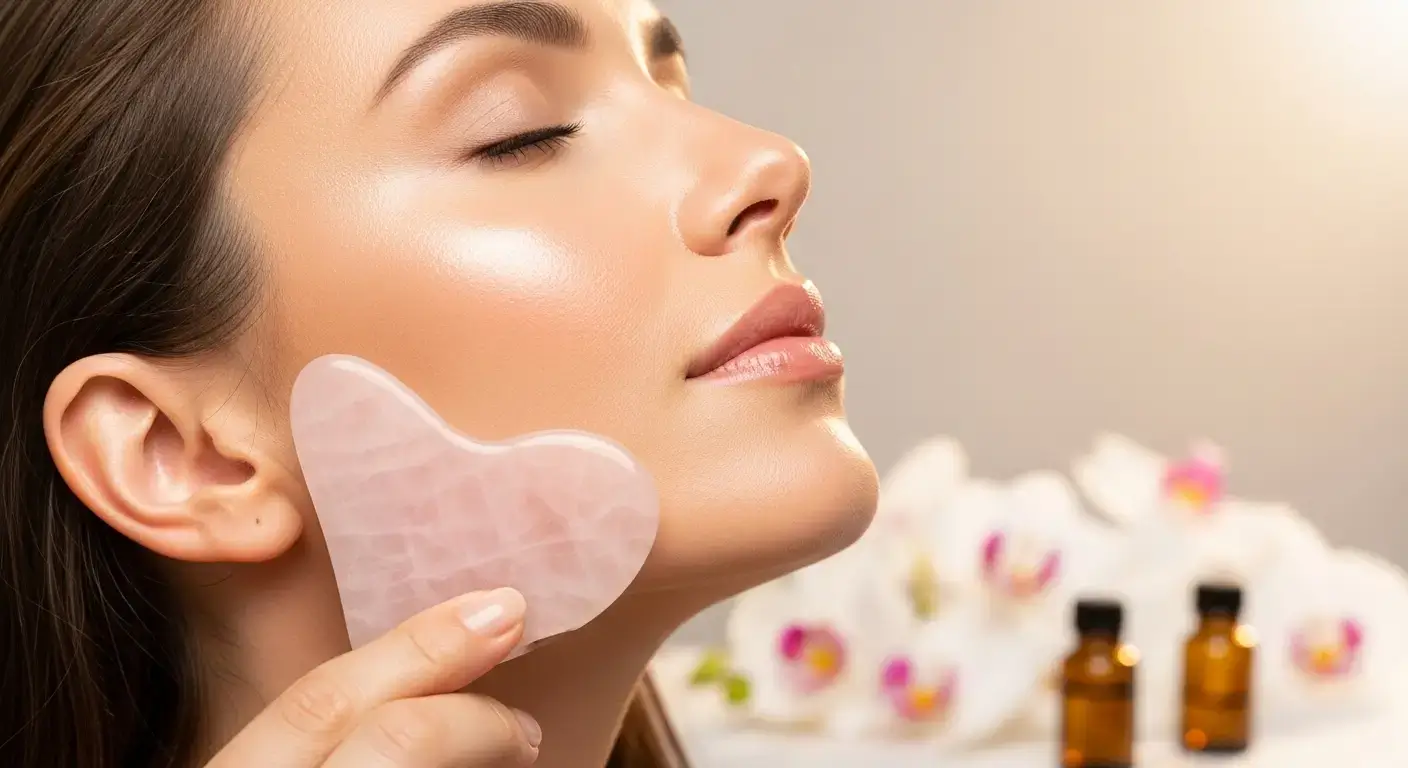
Sculpt your profile naturally. Discover the ultimate guide on gua sha for jawline and double chin. Expert techniques, tools, and tips inside!
Let’s be honest for a second. We’ve all had that moment—catching a glimpse of ourselves on a Zoom call or in a stray selfie angle and thinking, “Wait, where did my jawline go?”
I’ve been there. In our quest for a sharper profile, we often turn to expensive creams or consider invasive procedures. But sometimes, the most effective solution is an ancient one. Enter Gua Sha. It’s not just a social media trend; it’s a centuries-old Traditional Chinese Medicine (TCM) technique that, when done correctly, can be a total game-changer for facial sculpting.
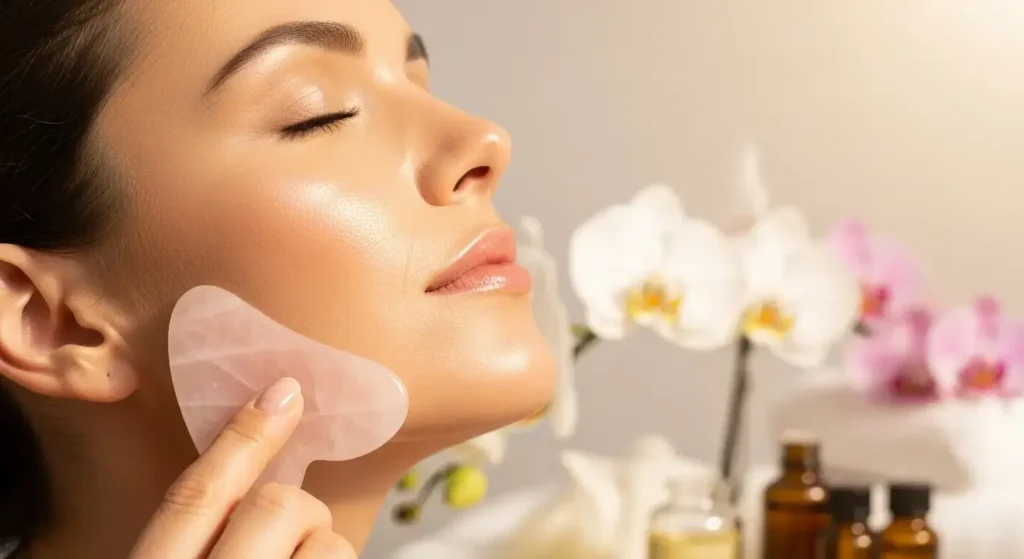
If you are looking to reduce puffiness and carve out those features, using gua sha for jawline and double chin reduction is one of the most natural, effective methods available. In this guide, I’m going to walk you through exactly how to do it, the science behind why it works, and the mistakes you absolutely need to avoid. Let’s get that glow (and sculpt) on! ✨
Table of Contents
- 1. The Science: Why Gua Sha Works for Double Chins
- 2. Choosing Your Weapon: The Best Tools for Jawline Sculpting
- 3. Step-by-Step Guide: How to Use Gua Sha for Jawline Definition
- 4. Common Mistakes That Kill Your Progress
- 5. Frequency & Expectations: When Will I See Results?
- 6. Frequently Asked Questions (FAQ)
The Science: Why Gua Sha Works for Double Chins 🤔
Before we start scraping away, it is crucial to understand why this works. A double chin isn’t always about fat; often, it’s about fluid retention and stagnant lymph.
Your lymphatic system is like your body’s garbage disposal, but unlike your heart, it doesn’t have a pump. It relies on movement and massage to flow. When you use gua sha for jawline and double chin issues, you aren’t “scraping off fat.” Instead, you are:
- Promoting Lymphatic Drainage: You are manually pushing stagnant fluid (which causes puffiness) toward your lymph nodes so it can be processed and eliminated.
- Releasing Fascia Tension: Tight muscles in the neck and jaw can pull the face down, contributing to a sagging appearance. Gua sha loosens these adhesions.
- Boosting Circulation: Increased blood flow brings oxygen to the skin, improving elasticity and tightness over time.
💡 Expert Insight
Think of your neck as the highway for your face. If the traffic on the highway (your neck) is jammed, the cars (fluid) can’t leave the city (your face). You must open up the neck pathways before working on the jawline!
Choosing Your Weapon: The Best Tools for Jawline Sculpting 💎
Walk into any beauty store, and you’ll see a dozen different stones. Does it matter? Yes and no. While the technique is more important than the stone, the shape is critical when focusing on the jaw.
| Tool Shape | Best For | Why it Works for Jawlines |
|---|---|---|
| Heart-Shaped | Jawline & Chin | The “V” notch fits perfectly over the jawbone, treating both the top and bottom simultaneously. |
| Wing/Fin Shaped | Full Face & Neck | The long edge is excellent for sweeping down the neck to drain lymph. |
| Spoon Shaped | Precision Work | Good for acupressure points, but less effective for broad sculpting. |
My recommendation: Go for a heart-shaped Bian stone or Rose Quartz. The notch is specifically designed to hug the mandibular bone, making it the superior choice for tackling a double chin.
Step-by-Step Guide: How to Use Gua Sha for Jawline Definition 🧖♀️
This is the part you came for. Follow this routine to maximize the benefits of gua sha for jawline and double chin reduction.
⚠️ Pre-Check!
Never use gua sha on dry skin! Apply a generous amount of facial oil (jojoba, squalane, or rosehip) to provide “slip.” Without oil, you will drag the skin, causing wrinkles and irritation.
Step 1: Open the Lymphatic Pathways (The Neck)
Do not skip this! Place the long curved edge of the tool at the base of your skull (behind the earlobe). Glide down your neck towards your collarbone. Repeat this 5-10 times on both sides. This clears the drain before we start dumping the water.
Step 2: Sculpt the Underside (The Double Chin Area)
Place the tool underneath your chin. Using the curved edge, sweep from the center of your throat (soft area under the chin) outwards towards your earlobe. Support the skin at your chin with your other hand to prevent stretching. Repeat 5-10 times.
Step 3: Carve the Jawline
Use the “V” notch or the heart shape of your tool. Place the chin in the center of the notch. Glide the tool along the jawbone towards the ear. Feel the tool hugging the bone. When you reach the ear, give a little wiggle to release tension in the masseter muscle (the chewing muscle).
Step 4: The Final Drain
Once you have finished the face movements, do a final sweep from behind the ear down the neck to the collarbone again. This flushes everything out.
Common Mistakes That Kill Your Progress 🚫
I see so many TikTok tutorials getting this wrong. If you aren’t seeing results from using gua sha for your jawline, you might be making these errors:
- Holding the tool at a 90-degree angle: This cuts into the skin. You want the tool almost flat against your face (about a 15-degree angle). Think “sweeping,” not “scraping.”
- Applying too much pressure: Harder is not better! The lymphatic system is right under the skin. Too much pressure bypasses the lymph and can cause bruising (petechiae). Use a light-to-medium touch.
- Ignoring the back of the neck: Tight neck muscles pull facial features down. Release the tension in the back of your neck (the nape) to effectively lift the front.
Frequency & Expectations: When Will I See Results? 📅
Consistency is key here. You wouldn’t go to the gym once and expect a six-pack, right? The same logic applies to facial sculpting.
- Instant Results: Immediately after a session, you will notice reduced puffiness and a slight “lift” due to fluid drainage. This is temporary but great for events.
- Long-term Results: Using gua sha for jawline and double chin consistently (3-4 times a week) for about a month will yield lasting changes. Your muscle tension will decrease, and your features will appear more defined permanently as inflammation subsides.
Conclusion: Your Journey to a Sculpted Face 📝
Incorporating gua sha into your evening routine is more than just a beauty hack; it’s a ritual of self-care. By dedicating just 5 minutes a day to these techniques, you aren’t just working on your exterior—you’re encouraging internal flow and health.
Remember, be gentle with your skin, stay consistent, and always ensure your tool has enough slip. Have you tried using gua sha for your jawline yet? I’d love to hear about your results or answer any questions in the comments below! 😊
Frequently Asked Questions ❓
Q: Can gua sha actually get rid of a double chin?
A: Gua sha can significantly reduce the appearance of a double chin caused by fluid retention, inflammation, and poor lymphatic drainage. However, it cannot remove genetic fat pads. For fat loss, overall weight management is required, but gua sha helps sculpt and define what is there.
Q: How often should I use gua sha for my jawline?
A: Ideally, aim for 3 to 4 times a week. You can do it daily if you use light pressure, but give your skin a break if it feels sensitive.
Q: Should I do gua sha in the morning or at night?
A: Both work! Morning is best for reducing puffiness from sleep (morning face). Night is best for releasing muscle tension from the day (especially if you clench your jaw).
Q: Which oil is best for gua sha?
A: Use non-comedogenic oils that won’t clog pores. Jojoba oil, Squalane, and Rosehip oil are excellent choices for most skin types. Avoid using water-based moisturizers as they absorb too quickly and cause the tool to drag.
“Gua Sha for Jawline and Double Chin: The Ultimate Sculpting Guide”에 대한 2개의 생각