
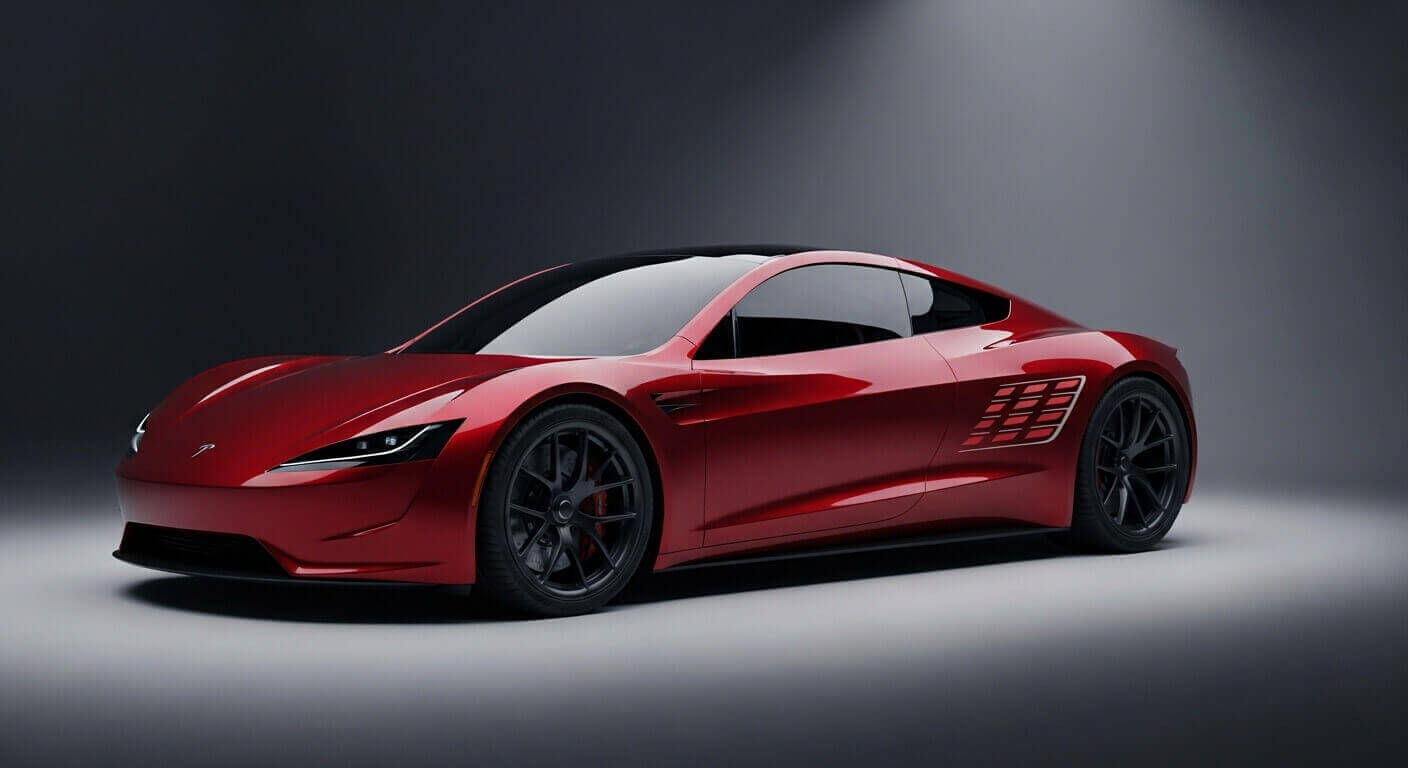
Frankly, when I heard Elon Musk on a recent podcast casually mention the 2025 Tesla Roadster might “fly,” I was skeptical. We’ve heard “flying car” promises for decades. But this time, it feels different. Musk wasn’t just launching a car; he was hinting at the convergence of his entire technological empire—from Tesla to SpaceX.
His claim that the new Roadster will be “far crazier than all James Bond cars combined” is a bold statement, but it’s not just marketing hype. It’s a signal. The long-awaited second-generation Roadster isn’t just an electric hypercar; it’s poised to be the ultimate technology showcase, a physical manifestation of Tesla’s massive pivot into an AI and robotics company.
In this analysis, we’ll break down what the “flying” Tesla Roadster *really* means, why its SpaceX-derived tech is a game-changer, and how it serves as the crowning jewel for Tesla’s ambitions in FSD, Robotaxis, and the Optimus humanoid robot.
Table of Contents
- The ‘Flying’ Tesla Roadster: What Does It Really Mean?
- The SpaceX Package & Cold Gas Thrusters Explained
- More Than a Car: Why the 2025 Roadster Matters
- Tesla’s AI Empire: How the Roadster Fits with Optimus & FSD
- Conclusion: A New Era for Tesla’s Tech Ambitions
- Frequently Asked Questions (FAQ)
The ‘Flying’ Tesla Roadster: What Does It Really Mean?
Let’s be clear: when Elon Musk says “fly,” he’s likely not talking about a true eVTOL (electric Vertical Takeoff and Landing) vehicle. You probably won’t be flying over traffic on your daily commute. The regulatory hurdles from the FAA, not to mention the immense battery power required for sustained lift, make this a near-impossibility for a 2025 production car.
The reality is something far more interesting and, frankly, more relevant to automotive engineering: the **SpaceX Package**.
The SpaceX Package & Cold Gas Thrusters Explained
This is a technology Musk has been referencing since 2017. The concept involves removing the rear seats and replacing them with a system of **Cold Gas Thrusters (CGTs)**. These aren’t miniature rocket engines burning fuel; they are high-pressure nozzles that vent compressed air (or an inert gas like nitrogen) stored in a composite-overwrapped pressure vessel.
What does this do for a car?
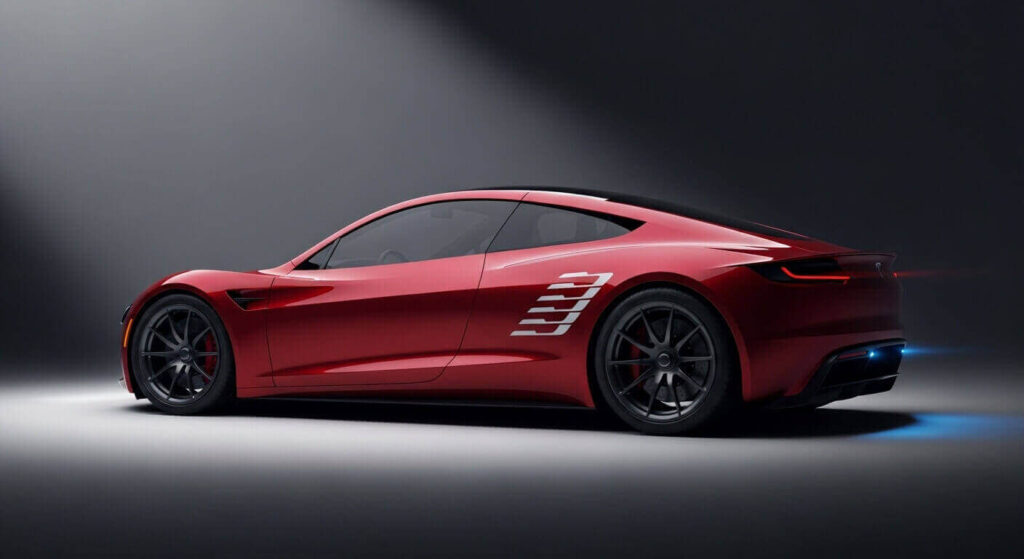
- Insane Acceleration: The thrusters would provide a massive, instant burst of thrust, supplementing the electric motors. This is how Musk can claim a 0-60 mph time of 1.1 seconds—a figure that is physically impossible with tires and an electric motor alone.
- Enhanced Dynamics: By vectoring thrust, the car’s AI could use the thrusters to dramatically improve cornering and braking, effectively “pushing” the car into the pavement for unnatural levels of grip.
- The “Jump”: This is the “flying” part. With enough thrust, the car could perform a “temporary levitation” or a short physical hop. While it might seem like a gimmick, it’s a terrifyingly effective demonstration of the technology’s power.
If this technology makes it to production, the Roadster won’t just be an electric car. It will be the first commercial ground vehicle to use rocket propulsion for performance, creating an entirely new category of “hypercar” and a new frontier for automotive engineering.
More Than a Car: Why the 2025 Roadster Matters
The Roadster was Tesla’s very first car. Its return, 17 years later, is deeply symbolic. This isn’t just a new model; it’s a **technology showcase** designed to prove Tesla’s absolute dominance in engineering.
The 2025 reveal event, expected in late 2025, won’t happen in a vacuum. It will be the pinnacle of a unified vision Tesla is presenting to the world, alongside its other core projects. It serves as the “halo” product that connects everything—showing the public what the same AI that powers their Robotaxi can do when completely unleashed.
Tesla’s AI Empire: How the Roadster Fits with Optimus & FSD
The Roadster is the “wow” factor, but the real story is the AI ecosystem that makes it possible. The same core technology—the AI, the data, the computing power—is being leveraged across all of Tesla’s most ambitious projects.
FSD and the Robotaxi Network
Tesla‘s Full Self-Driving (FSD) is the foundation. The “Robotaxi” concept, which is already being spotted in new states like Arizona after initial testing in Texas and California, is the commercialization of this AI. The real-time, vision-based decision-making required for FSD to navigate a complex city is the exact same AI that will be needed to manage rocket thrusters on the Roadster without the car flying apart. It’s a problem of advanced vehicle dynamics and AI control.
AI, XAI, and the Optimus Humanoid
This is where it gets even bigger. Tesla’s AI development, combined with the efforts at XAI, is forming a massive AI cluster in Palo Alto. They are hiring the world’s top AI engineers to work on everything from FSD to the Grok AI.
This AI is also the “brain” for **Optimus**, Tesla’s humanoid robot. The goal is to create an AI that can understand and interact with the real, messy, physical world. The AI that learns to drive a car (FSD) is the same AI that learns to walk and perform tasks (Optimus). The Roadster is simply the most extreme example of this AI’s control over a physical-world machine.
The Neuralink Connection: Thought-Controlled Machines?
The synergy extends even further. We are already seeing demonstrations of Neuralink patients controlling computers with their thoughts. Musk has openly discussed the potential for a Neuralink patient to one day control an Optimus robot. This suggests a future where the human mind, Tesla’s AI, and robotic hardware are all part of a single, integrated ecosystem.
The Bigger Picture: Supercharger Diners & Infrastructure
Finally, Tesla is even redesigning the culture around its technology. The “Supercharger Diner” concept, a drive-in theater and restaurant combined with charging, is expanding from its successful LA proof-of-concept to key hubs like Austin and Palo Alto. This isn’t just a charger; it’s an experience, integrating the electric vehicle lifestyle into a new form of entertainment and community. It proves Tesla is thinking about the entire ecosystem, from the car to the charger to the AI that drives it.
Conclusion: A New Era for Tesla’s Tech Ambitions
The 2025 Tesla Roadster is so much more than a fast car. It’s an icon, a symbol of Tesla’s audacious technological challenge to the world. It’s the bridge between automotive engineering, aerospace propulsion, and artificial intelligence.
For investors, technologists, and consumers, the two key takeaways are:
- Watch the AI Integration: The real story is how FSD, Optimus, and XAI are converging. This is the engine of Tesla’s future value.
- Explore the Core Science: The cold gas thrusters are not a gimmick. They represent a fundamental fusion of scientific principles from different fields, and it’s a sign of what’s to come.
Tesla’s future isn’t just about cars anymore. It’s about the intersection of AI and robotics. The 2025 Roadster reveal will be the moment we get to see that future, at full throttle.
Frequently Asked Questions (FAQ)
Q: Will the 2025 Tesla Roadster actually fly?
A: No, not like a traditional airplane or “flying car” (eVTOL). The “flying” feature refers to the SpaceX Package, which uses cold gas thrusters. This will allow the car to perform a short “hop” or “jump” and, more importantly, achieve unprecedented acceleration (like 0-60 in 1.1 seconds) and cornering.
Q: What is the SpaceX Package on the Tesla Roadster?
A: The SpaceX Package is an optional upgrade that replaces the rear seats with a high-pressure compressed air tank and a system of cold gas thrusters (CGTs). These thrusters expel air to provide massive, instant thrust, dramatically improving performance far beyond what’s possible with tires alone.
Q: When will the new Tesla Roadster be released?
A: Elon Musk has stated the official reveal will be in 2025, with production and deliveries planned to start after that. Given Tesla’s history with ambitious projects, this timeline is a target and could be subject to change.
Q: How is the Roadster connected to Tesla’s Optimus robot?
A: Both the Roadster (with the SpaceX package) and the Optimus robot rely on the same core Tesla AI. This AI must understand and control complex, real-time movements in the physical world. The AI that learns to control thrusters on the Roadster is the same foundational AI that learns to help Optimus walk, balance, and perform tasks.
Q: Will the SpaceX Package be legal on the street?
A: This is a major unanswered question. The legality of using high-powered thrusters on a public road is uncertain and will depend on regulators like the FAA and DOT. It’s possible the feature will be software-limited for use only on private tracks.
“2025 ‘Flying’ Tesla Roadster: How SpaceX Tech & AI Built the Ultimate Hypercar”에 대한 1개의 생각