
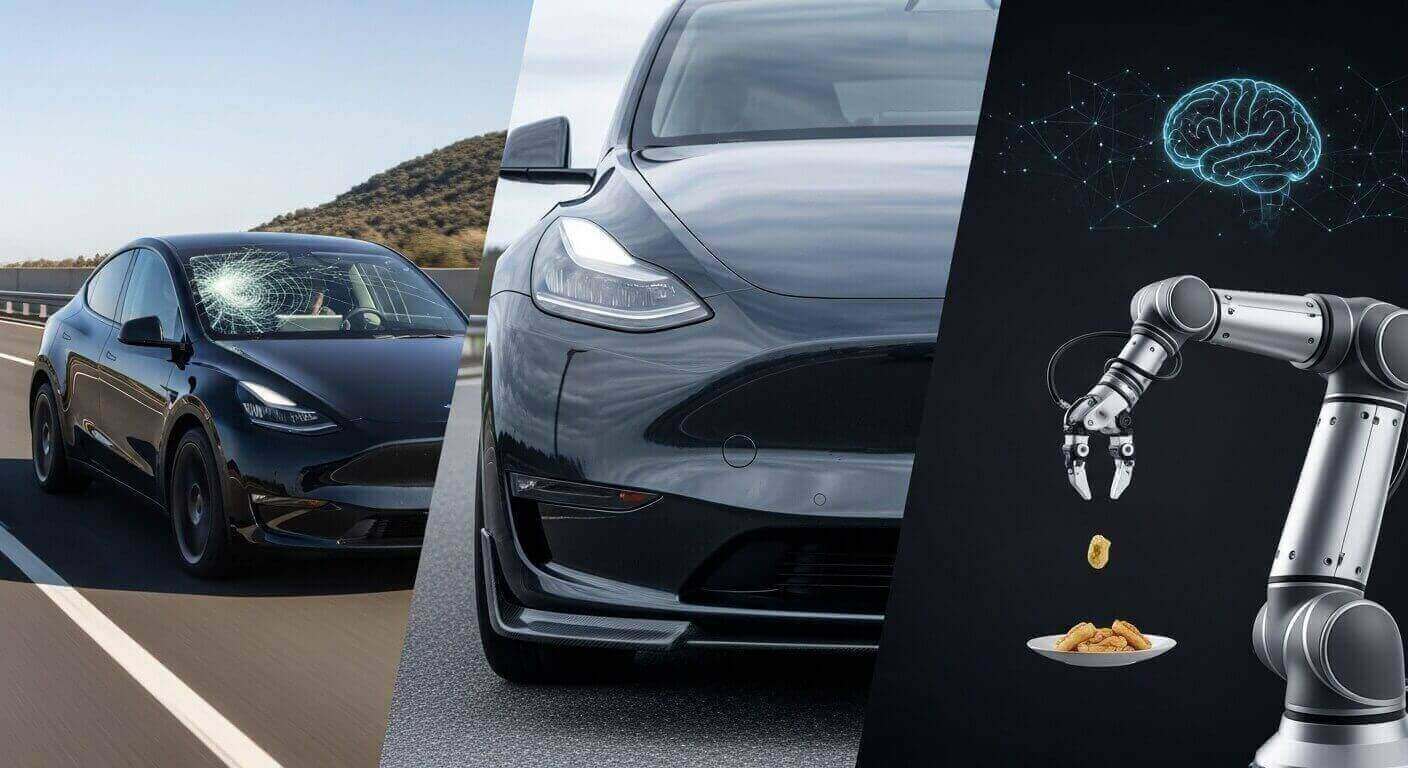
We’ve all had that heart-stopping moment on the road—a sudden glare, a piece of debris, or a moment of distraction. But what happens when the threat is truly catastrophic? Recently, Tesla’s Full Self-Driving (FSD) technology was put to the ultimate test in a freak accident that sounds like science fiction. A driver’s life was saved, not by reflexes, but by software.
This incident is more than just a viral story; it’s a powerful demonstration of the future of autonomous safety. In this article, we’ll analyze this incredible event, dive into the new design and engineering philosophy behind the updated Model Y Performance, and explore the groundbreaking progress of Neuralink’s BCI-controlled robotic arm. This isn’t just about what’s next; it’s about the innovations that are already changing our world.
Table of Contents
- Part 1: A Life Saved: How Tesla FSD Handled a Catastrophic Failure
- Part 2: Deconstructing the New Model Y Performance: Beyond Just Speed
- Part 3: The Next Frontier: Neuralink’s BCI and the Dawn of Physical Independence
- Conclusion: We Are Living in the Future of Safety and Ability
- Frequently Asked Questions (FAQ)
Part 1: A Life Saved: How Tesla FSD Handled a Catastrophic Failure
The “Meteor” Incident: What Really Happened?
The story comes from Australia, where a Tesla Model Y owner was driving on a highway at approximately 68 mph (110 km/h). In a shocking turn of events, a high-velocity projectile—suspected by the driver to be a micro-meteorite or extreme road debris—struck the windshield. The impact was explosive, shattering the glass and sending fragments and dust throughout the cabin.
The driver was instantaneously incapacitated. Blinded by the debris and in a state of shock, he was unable to control the vehicle. In 99% of similar scenarios, this would have resulted in a devastating, high-speed collision.
Why Tesla FSD Succeeded: Beyond “Autopilot”
This is where the technology took over. The car, operating on FSD (Full Self-Driving Beta), didn’t swerve or panic. While the human driver was blinded, the car’s “eyes”—its suite of vision-based cameras—remained fully operational. The underlying neural network continued to process the road, identify the lane markings, and maintain the vehicle’s trajectory safely.
The driver, once he regained his bearings, found the car had maintained perfect control, allowing him to safely pull over. He later stated, “It was a real stroke of luck I was in a Tesla, the safest car on the road.” This event powerfully demonstrates Tesla’s core safety philosophy: minimize the probability of a collision, even in the face of unpredictable, black-swan events.
A Global Vote of Confidence in FSD Safety
This individual experience is being echoed by a growing global trust in the technology. In Israel, a petition signed by nearly 1,000 Tesla owners urging for the approval of FSD was submitted to the government. In a remarkable response, Israel’s Minister of Transport officially endorsed a plan for the rapid approval and market entry of FSD, citing its potential to significantly enhance road safety. This signals a major shift from seeing FSD as an experiment to recognizing it as a vital safety tool.
Part 2: Deconstructing the New Model Y Performance: Beyond Just Speed
“Designed for the Enthusiast”: A New Performance Philosophy
Tesla’s Chief Designer, Franz von Holzhausen, and the engineering team recently detailed the philosophy behind the new, updated Model Y Performance. This isn’t just a software unlock; it’s a dedicated engineering effort to create a car “for the enthusiastic user.” The goal was to enhance the car’s high-performance capabilities without sacrificing the practicality that makes the Model Y the world’s best-selling car.
Key Upgrades in the 2024 Model Y Performance
So, what’s actually different? The changes are comprehensive:
- Raw Performance: The car achieves a blistering 0-60 mph time of just 3.5 seconds.
- New Adaptive Suspension: This is perhaps the biggest update. The new model features an adaptive damping system that fundamentally changes the ride. It can be soft and comfortable for daily commuting but becomes firm and responsive during spirited driving, finally solving the “too-stiff” criticism of previous models.
- Aggressive Aerodynamics: The new design is functional. It includes a longer, more pronounced front splitter, a new rear diffuser, and an extended carbon fiber rear spoiler. These elements work together to increase downforce and improve high-speed stability.
- Refined Design & Materials: The car features new 21-inch “Arachnid” wheels that reduce aerodynamic drag. Inside, the cabin is elevated with sporty, bolstered seats, carbon fiber trim, and premium microsuede materials.
- Improved Practicality: Crucially, the engineering changes to the suspension and aerodynamics also led to an improved rear-seat ride comfort, making this high-performance vehicle an even better daily driver.
Part 3: The Next Frontier: Neuralink’s BCI and the Dawn of Physical Independence
Meet Alex Conley: A Patient’s Journey with a Robotic Arm
Parallel to Tesla’s innovation, Elon Musk’s other venture, Neuralink, is making extraordinary strides. The second implant patient, Alex Conley, who suffers from quadriplegia due to a spinal cord injury, has shown remarkable results in the ‘Komboy’ study.
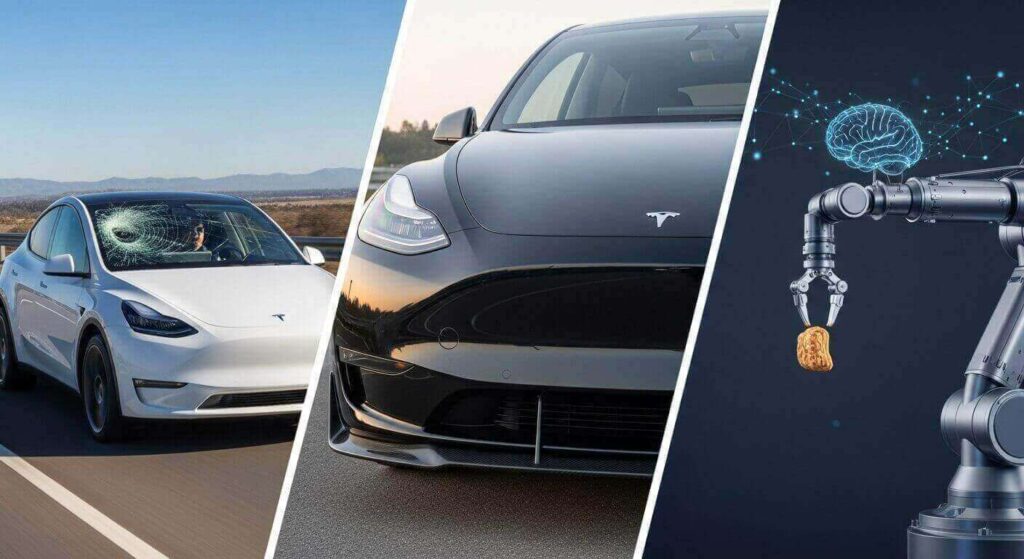
Using the Neuralink Brain-Computer Interface (BCI), Alex is now able to control a robotic arm purely with his thoughts. In a recent demonstration, he was able to have the arm open a refrigerator, retrieve a snack, place it in a microwave, and feed himself.
This is a life-altering breakthrough. “It gives me the confidence to be able to do things on my own, without having to rely on someone else,” Alex shared.
From Science Fiction to Real-Life Hope for Millions
This achievement cannot be overstated. It’s a fundamental leap towards restoring autonomy for people with severe physical disabilities. Neuralink’s progress provides tangible hope for physical independence and an improved quality of life for millions worldwide, moving the concept from the pages of science fiction directly into the realm of medical reality.
Conclusion: We Are Living in the Future of Safety and Ability
The incredible safety performance of Tesla’s FSD and the empowering breakthroughs from Neuralink prove that the future we’ve been promised is arriving now. Autonomous driving is evolving from a mere convenience into a life-saving protection technology. Brain-Computer Interfaces are becoming a revolutionary tool to overcome human limitations.
Key Takeaways & Actionable Insights
- Redefine the Value of Autonomous Driving: When considering technologies like FSD, view them not as a luxury or option, but as a critical investment in the safety of yourself and your family.
- Monitor BCI Developments: The pace of BCI technology like Neuralink is staggering. Keep an eye on investment and technological trends in this space to prepare for the profound changes it will bring to healthcare and human ability.
You are witnessing these miracles of technology as they happen. Now is the time to consider: how will these revolutionary innovations change your life?
Frequently Asked Questions (FAQ)
Q: Did Tesla FSD really save a driver from a meteor?
A: The driver reported the object as a suspected micro-meteorite due to its high velocity and explosive impact. While not officially confirmed, the object—whether a meteor or extreme road debris—shattered the windshield and incapacitated the driver. The key fact is that FSD maintained complete control of the car, preventing a high-speed crash.
Q: What are the biggest differences in the new Model Y Performance?
A: While it’s still incredibly fast (0-60 mph in 3.5 seconds), the most significant upgrade is the new adaptive suspension. This provides a much more comfortable ride for daily driving while also improving handling for spirited driving. Other key changes include more aggressive aerodynamics (new splitter and diffuser) and a premium interior with carbon fiber and bolstered seats.
Q: How does the Neuralink BCI help a patient like Alex Conley?
A: For a patient with quadriplegia, the Neuralink BCI reads the neural signals for intended movement directly from the brain. It then translates these thoughts into digital commands. In Alex’s case, these commands are sent to a robotic arm, allowing him to control it with his mind to perform complex tasks like opening a fridge, handling objects, and feeding himself, granting him a level of physical independence he lost.
“Tesla FSD Saves Driver in Freak “Meteor” Strike; New Model Y & Neuralink Updates”에 대한 1개의 생각