

Why is the 40-year-old Mercedes-Benz W123 300D a legend? Discover the ‘over-engineering’ & revolutionary turbodiesel that define this classic car.
When you hear the term “classic car,” you might picture a finicky, fragile machine that spends more time in the garage than on the road. But what if I told you about a 40-year-old car that was built to be a daily driver, a car that scoffed at planned obsolescence, and a car that introduced the world to the idea that a diesel could be… well, *not* painfully slow? That car is the Mercedes-Benz W123, and specifically, the legendary 300D Turbodiesel. 😊
For an entire generation, the W123 was simply *the* Mercedes-Benz. It was the car a Swiss doctor drove to his practice and the same car a Cairo taxi driver used to log a million miles. It’s the direct ancestor of today’s E-Class, and frankly, it set a bar for quality that many, including Mercedes-Benz itself, have struggled to reach ever since. We’re not just talking about a car; we’re talking about a masterpiece of “over-engineering.”
Table of Contents
- A Timeless Masterpiece: The Birth of the W123
- The Icon of Innovation: The 300D Turbodiesel’s Secret
- ‘Over-Engineering’: What Makes the Mercedes-Benz W123 Unkillable?
- The W123 Interior: Where ‘Old’ and ‘Modern’ Coexist
- The Driving Experience: Why You Should Drive a W123 Today
- The Enduring Legacy of a True Classic Car
A Timeless Masterpiece: The Birth of the W123 🤔
Launched in 1976, the Mercedes-Benz W123 series was a replacement for the W114/W115 “Strich-Acht” models. It wasn’t a radical styling departure, but rather a careful, profound evolution. This was the mid-size sedan for the discerning buyer, and it immediately became a runaway success. Over its 11-year production run (from 1976 to 1986), Mercedes-Benz built nearly 2.7 million of them. Think about that. This wasn’t a cheap car, yet it sold in volumes that rival modern mass-market vehicles.
Why? Because it was designed with a singular philosophy: “Das Beste oder nichts” (The best or nothing). The W123 was arguably the peak of this “over-engineering” era. It was a car built to a standard, not to a price. From its robust chassis to its simple, repairable mechanicals, it was designed to last a lifetime. And in many cases, it has.
The Icon of Innovation: The 300D Turbodiesel’s Secret 📊
Let’s talk about the 300D. The standard W123 300D was equipped with the OM617, a 3.0-liter five-cylinder diesel engine. It was famously reliable but also famously slow, chugging out a leisurely 80-something horsepower. It was a car you *waited* for.
But then, Mercedes did something revolutionary. While they had first experimented with a turbodiesel in the 1978 300SD (W116) for the US market, it was the W123 300D Turbodiesel (introduced for the 1981 model year) that brought this technology to the mainstream mid-size market. By adding a turbocharger, the OM617 engine’s output jumped to around 125 horsepower.
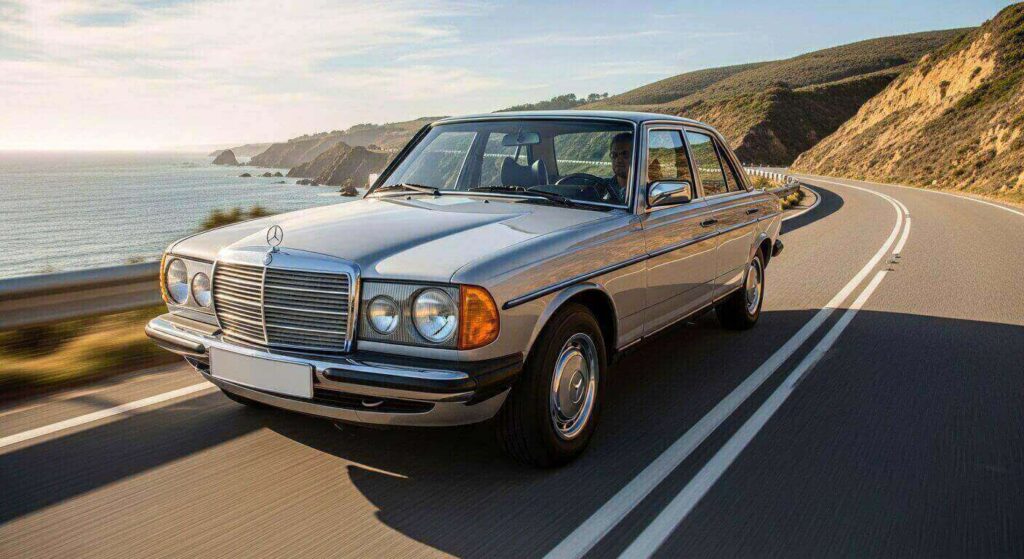
Today, 125 hp sounds tiny. But in 1981, it was a game-changer. It slashed the 0-60 mph time from a glacial 16+ seconds to a merely deliberate 14 seconds. More importantly, it gave the car the torque it needed to merge onto American highways and cruise comfortably at modern speeds. This car *invented* the idea of the practical, everyday turbodiesel sedan.
Mercedes was so proud of this new tech that they even underlined the “Turbodiesel” lettering on the trunk lid emblem. It was a clever bit of marketing that also, coincidentally, reduced production costs by tying the individual letters together. Practical and smart—that’s the W123 in a nutshell.
‘Over-Engineering’: What Makes the Mercedes-Benz W123 Unkillable? 🛠️
This is the core of the W123 legend. “Over-engineering” isn’t just a buzzword; it was a tangible design ethos. It’s the reason so many are still on the road 40 years later.
- The “Bank Vault” Feel: The first thing any W123 owner will show you is the door slam. It doesn’t “click”; it “thunks.” It sounds like you’re closing a commercial freezer. The panel gaps are consistent, and the entire body feels like it was carved from a single block of steel.
- The Indestructible Engine: The OM617 diesel engine is famous for being one of the most reliable engines ever made. It’s not uncommon to see these cars with 500,000, 750,000, or even over a million miles on the original engine and transmission.
- Quirky but Durable Tech: The W123 doesn’t use electrics for its accessories. It uses engine vacuum. The central locking, the climate control vents, and even the engine shut-off are all powered by a complex but incredibly robust system of vacuum lines. It’s a beautifully mechanical solution that avoids the finicky 1970s/80s electronics that plagued other brands.
- Designed for Repair: Unlike modern cars, which are designed to be replaced, the W123 was designed to be repaired. The engine bay has ample space to work, parts are modular, and the car’s mechanical simplicity means a competent home mechanic can keep one running indefinitely.
The W123 Interior: Where ‘Old’ and ‘Modern’ Coexist 🛋️
Sitting inside a W123 is a fascinating experience. You won’t find any giant touchscreens or flashy digital gauges. What you will find is a masterclass in quality and ergonomics. The switchgear clicks with a satisfying, tactile precision that you just don’t find anymore.
The seats are often upholstered in MB-TEX, a synthetic leather (vinyl) material that is, without exaggeration, indestructible. After 40 years and hundreds of thousands of miles, these seats often look brand new, with no cracks or tears. It perfectly symbolizes the car’s long-term focus.
What’s truly shocking, though, is the list of modern features you could get in this “old” car:
- Automatic Climate Control (a sophisticated system for its time)
- Power Windows (all four!)
- Cruise Control
- A 4-speed automatic transmission (with a “Sport” mode, believe it or not)
- Heated seats
Of course, this coexists with the hilariously “old-school” features, like the massive steering wheel, the manual-adjust side mirror, and the complete and total lack of cupholders. It’s a perfect blend of vintage charm and surprising practicality.
The Driving Experience: Why You Should Drive a W123 Today 🚗
So, what’s it like to drive a W123 300D Turbodiesel today? As the analyst in the source video noted, it’s “shockingly modern.”
Let’s be clear: it is not fast. A modern minivan will leave it in the dust. But “fast” isn’t the point. The W123 is about *momentum*. You hear the distinct five-cylinder diesel clatter at a stoplight, but as you pull away, the turbo spools up with a faint whistle, and the car moves with a solid, undeniable wave of torque. It’s smooth, confident, and feels utterly unstressed.
The ride quality is magnificent. It soaks up bumps like a car twice its size, yet it never feels floaty or disconnected. The steering is slow, but it’s precise and weighted perfectly. You don’t “point and shoot” a W123; you *guide* it. The entire experience is one of solidity, safety, and mechanical harmony. It’s relaxing in a way modern, high-strung cars simply can’t be.
The Enduring Legacy of a True Classic Car 🌟
The Mercedes-Benz W123 300D isn’t just a classic car; it’s a rolling testament to a time when “quality” was the number one priority. It’s the car that cemented Mercedes-Benz’s reputation for a generation.
Today, it’s beloved by everyone from classic car purists to young hipsters because it’s one of the few 40-year-old vehicles that you can realistically drive every single day. The massive production numbers mean parts are still widely available, and its simple design makes it a joy to own and maintain.
In our modern world of disposable products and digital everything, the W123 300D Turbodiesel stands as a proud, mechanical monument. It’s a legend because it was built to be one, and it proves that true quality is, and always will be, timeless.
Frequently Asked Questions (FAQ) ❓
Q: Is the Mercedes W123 300D really that reliable?
A: Yes. The W123, especially the diesel models with the OM617 engine, is world-renowned for its reliability. It’s not uncommon to find examples that have traveled over 500,000 miles with only regular maintenance. Its mechanical simplicity and “over-engineered” components are the primary reasons for its legendary durability.
Q: Is the W123 300D Turbodiesel fast?
A: By modern standards, no. A 0-60 mph time of around 14 seconds is slow. However, compared to its non-turbo diesel siblings (like the 240D), it was significantly faster. Its real strength is its torque, which makes it feel confident and capable in city driving and on the highway.
Q: What exactly is “over-engineering” in the W123?
A: “Over-engineering” refers to the practice of designing components to be far more robust or durable than necessary. In the W123, this is seen in the indestructible MB-TEX interiors, the “bank vault” solid doors, the use of a durable vacuum system instead of fragile electronics, and an engine (OM617) built to last for a million miles.
Q: What is the difference between a W123 240D and a 300D?
A: The main difference is the engine. The 240D uses a 2.4-liter 4-cylinder diesel engine (OM616), which is extremely reliable but very slow (around 67-72 hp). The 300D uses a 3.0-liter 5-cylinder diesel (OM617), which offers more power and torque (around 80-88 hp). The 300D *Turbodiesel* adds a turbo to that 5-cylinder engine, boosting it to ~125 hp.
Q: Is the Mercedes-Benz W123 a good classic car for a beginner?
A: It is often considered one of the *best* classic cars for a beginner. Its legendary reliability means you’ll spend more time driving than fixing. Parts are still widely available and affordable, and its simple mechanics make it relatively easy to work on. It offers a true vintage experience with modern-day usability.