
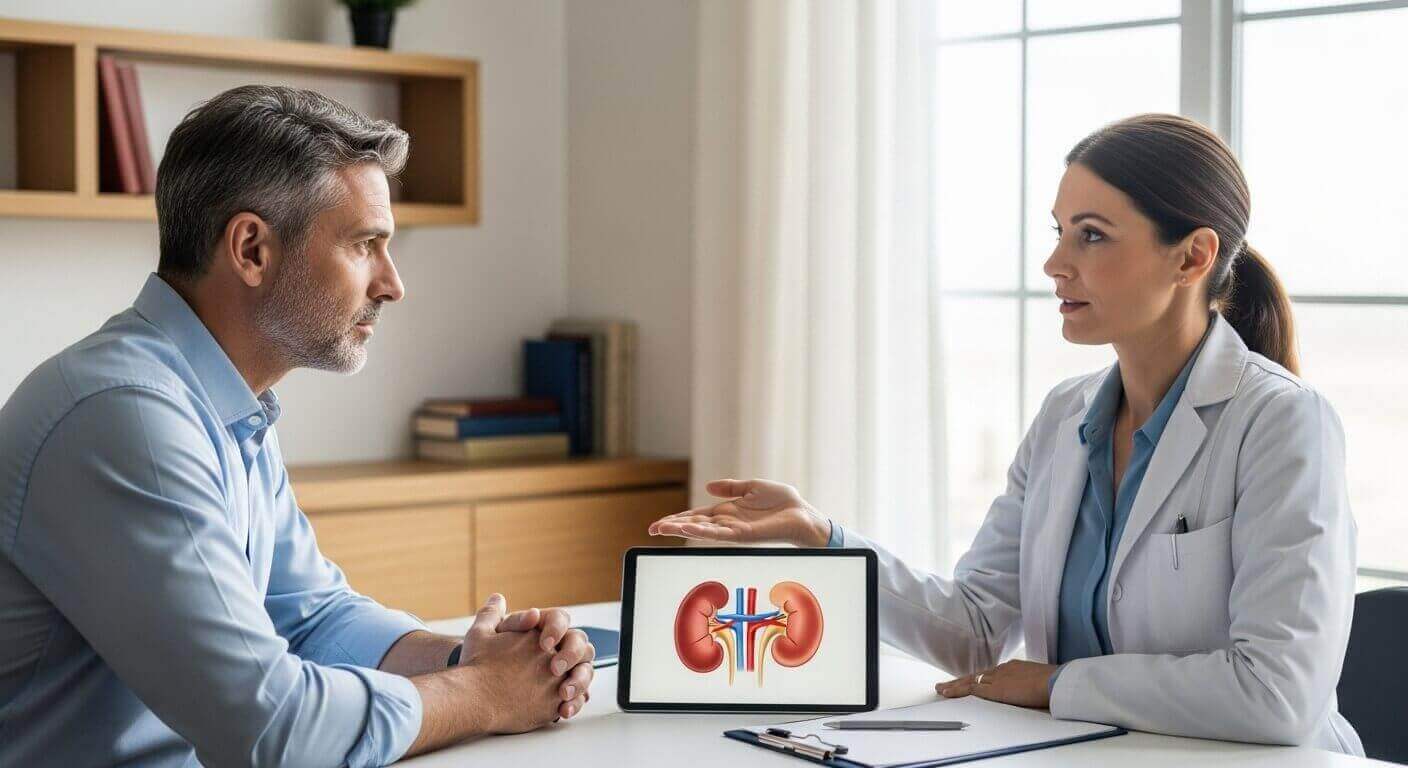
Stop confusing prostate health with virility. A urologist-backed guide to debunking myths about supplements like Saw Palmetto and finding the real, expert-backed keys to male stamina and sexual health.
We’ve all seen them. The late-night commercials and flashy online ads promising to “restore your manhood” or claiming “the nights have changed.” They use enticing terms like Saw Palmetto or Octacosanol, paired with suggestive stories of boundless energy and “revitalized” performance.
But let’s be honest. Many of these ads prey on a common anxiety and a profound misunderstanding. They create what urology experts call an “information bias”—the false equation that **prostate health = virility**.
If you’re worried about your performance, or if you’ve been tempted by these “quick fixes,” you are not alone. The truth, however, is that your declining “stamina” or sexual function might have very little to do with your prostate. In fact, a significant number of these issues stem from lifestyle habits and muscle fatigue, not a “weak” prostate.
This article isn’t a sales pitch. It’s an expert-backed guide. We will dismantle the commercial myths and give you the actionable, medically-sound strategies that urologists recommend for addressing the *real* root causes of prostate issues and sexual dysfunction.
Table of Contents
- The Great Male Health Myth: Why Prostate Health Isn’t ‘Virility’
- What Really Causes Low Stamina and Sexual Dysfunction?
- Real-Life Cases: When ‘Too Much’ Is the Real Problem
- 3 Expert-Backed Strategies for Prostate Health and Stamina
- Why You Must See a Urologist (And What to Expect)
- Conclusion: Ditch the Hype, Focus on Real Health
- Frequently Asked Questions (FAQ)
The Great Male Health Myth: Why Prostate Health Isn’t ‘Virility’ 🤔
First, we need to separate two very different concepts. In Korean, the word is “정력” (jeong-ryeok), which doesn’t have a perfect English equivalent. It’s a blend of virility, stamina, libido, and sexual power. Advertisers love this vague, emotional term.
“Prostate health,” on the other hand, is a specific medical term. The prostate is a small gland (about the size of a walnut) with one primary job: to produce the fluid that nourishes and transports sperm (semen).
Here is the critical distinction: The prostate has little to do with the *desire* for sex (libido) or the *ability* to achieve an erection (erectile function). Those are primarily driven by hormones (like testosterone), blood flow, and psychological factors.
Supplements like Saw Palmetto are often studied for their potential (and debated) effects on Benign Prostatic Hyperplasia (BPH)—an enlargement of the prostate that causes urinary symptoms, like a weak stream or frequent urination. This has *nothing* to do with sexual performance. Conflating the two is a dishonest marketing tactic.

What Really Causes Low Stamina and Sexual Dysfunction? 📊
If you feel your “virility” is fading, urologists suggest looking at the whole picture before blaming your prostate. The real culprits are often hiding in plain sight.
The True Culprits: Lifestyle, Hormones, and Overuse
Before you buy a single supplement, ask yourself about these factors:
- Psychological Factors: Stress, anxiety (especially “performance anxiety”), depression, and relationship issues are the number one killers of libido and erectile quality.
- Vascular Health: Your ability to get an erection is 100% about blood flow. Conditions like high blood pressure, high cholesterol, diabetes, and smoking all damage your blood vessels, leading directly to erectile dysfunction (ED).
- Hormones: Low testosterone (Low T) can absolutely crush your sex drive. This is a medical condition that needs to be diagnosed with a blood test, not guessed at.
- Physical Fatigue & Overexertion: This is the big one that marketing ignores. The muscles involved in sex—especially your pelvic floor—can get tired, just like any other muscle.
How Prostate *Issues* Can Have an Indirect Effect
This isn’t to say prostate problems are irrelevant. They just don’t cause “low virility” directly. Instead, they cause symptoms that make sex difficult or unpleasant.
- BPH (Enlarged Prostate): This makes you wake up 3-5 times a night to urinate. The result? You’re exhausted. And exhaustion is terrible for your sex drive.
- Prostatitis (Prostate Inflammation): This can cause significant pain, especially during or after ejaculation. When sex hurts, you naturally avoid it. This isn’t a problem of “potency”—it’s a problem of pain.
Real-Life Cases: When ‘Too Much’ Is the Real Problem 👨💻
To understand this better, let’s look at two (anonymized) cases that urologists often see. This is the “Experience” part of the E-E-A-T equation that Google values, showing real-world application.
Case Study 1: The 30-Year-Old with “Functional Fatigue”
A man in his 30s visits a urologist, convinced he has prostatitis. His symptoms include a feeling of weakness and discomfort after sex. The doctor asks about his habits. The patient reveals he met a new partner and, for the past month, has been having sex (and masturbating) 6+ times per week—a dramatic increase from his norm.
The Diagnosis: No infection. No prostate disease. He was suffering from pelvic floor muscle dysfunction. His core and pelvic muscles were simply exhausted from overuse. The solution wasn’t a pill; it was rest and moderation.
Case Study 2: The 60-Year-Old Aggravating BPH
A man in his 60s, already being treated for BPH (urinary symptoms), reports that his symptoms have suddenly worsened. He also notes a decrease in semen volume. He’s worried his prostate is “failing” and that this is the end of his sex life.
The Diagnosis: After a careful discussion, the patient admits he recently tried to increase his sexual frequency to “test” himself. This frequent ejaculation and pelvic activity aggravated his already-sensitive prostate, worsening his urinary symptoms. The decreased volume was simply because his body didn’t have time to regenerate the fluid. The solution was to return to a moderate, comfortable sexual pattern that didn’t aggravate his underlying condition.
In both cases, the answer wasn’t a “virility” supplement. It was a correct diagnosis and an honest assessment of their sexual habits.
3 Expert-Backed Strategies for Prostate Health and Stamina 🚀
Instead of unproven supplements, medical experts recommend three core “actionable takeaways” to fundamentally improve your urinary and sexual health.
1. Practice ‘Scaled’ Sexual Moderation
This is the primary treatment for functional fatigue. “Scaled moderation” means finding a sexual pattern that fits your body’s current state. As seen in the case studies, excessive ejaculation (from sex or masturbation) can fatigue the pelvic floor and irritate the prostate. Your body needs time to recover. There is no “magic number”—it’s about listening to your body and finding a sustainable rhythm that doesn’t cause pain or discomfort.
2. Rehabilitate Your Pelvic Floor (Kegel Exercises)
This is one of the most effective things men can do, and it’s completely free. The pelvic floor muscles support your bladder, bowel, and sexual function. When they are weak *or* too tight, problems arise.
- How to do Kegels: The next time you urinate, try to stop the stream mid-flow. The muscles you use to do that are your pelvic floor muscles. (Don’t do this regularly, just to identify them). Now, when you’re not urinating, squeeze those muscles, hold for 3-5 seconds, and then fully relax for 3-5 seconds. Repeat this 10-15 times, 2-3 times a day.
- Add Warmth: Urologists also recommend warm baths (or “sitz baths”) to help relax these muscles. Tight, tense pelvic muscles (from stress or overuse) can be just as problematic as weak ones.
When combined with prescription medication for diagnosed issues, this pelvic rehabilitation is highly effective at improving urinary symptoms.
3. Get a Professional Diagnosis and Real Medicine
This is the most critical step. Stop self-diagnosing with online forums and supplement ads. If you have symptoms, see a urologist. They will give you an accurate diagnosis for your specific issue, which may be:
- BPH: Can be effectively managed with prescription medications (like alpha-blockers) that relax the prostate and improve urine flow.
- Prostatitis: May require antibiotics if bacterial, or anti-inflammatories and muscle relaxants if it’s chronic pelvic pain syndrome (CPPS).
- Erectile Dysfunction: May be the first sign of a serious cardiovascular issue, and a doctor can prescribe proven medications (like PDE5 inhibitors) *after* checking your heart health.
Trusting a medical professional is the fastest and most reliable path to a real solution.
Why You Must See a Urologist (And What to Expect) 🩺
Many men avoid the urologist out of fear or embarrassment. This is a major barrier to getting healthy. Let’s demystify the visit to build trust.
A urologist is a medical doctor who specializes in the urinary tract and male reproductive system. They are trained, non-judgmental professionals. A typical exam for prostate/sexual health concerns involves:
- A Detailed Talk: They will ask you specific questions about your symptoms, lifestyle, habits, and medical history. This is the most important part. Be honest.
- A Urine Test: To check for infection or blood.
- A Blood Test: They will likely check your **PSA (Prostate-Specific Antigen)** levels to screen for prostate cancer and may check your testosterone levels.
- A Physical Exam: This may include a **Digital Rectal Exam (DRE)**, which is a quick (10-second) exam where the doctor feels the prostate to check its size and for any abnormalities. It’s slightly uncomfortable but not painful, and it provides vital information.
Based on this, they can build a complete picture of your health, separate myth from reality, and create a treatment plan that actually works.
Conclusion: Ditch the Hype, Focus on Real Health 📝
Prostate health is not a mystical source of “virility.” It’s a tangible part of your anatomy that, like any other body part, requires sensible care and expert attention when problems arise.
The next time you see an ad promising to restore your sexual power with an exotic herb, remember the facts. Real health and performance come from a holistic approach: understanding your body, practicing moderation, strengthening your foundational muscles, and trusting medical science over commercial hype.
Your health is not a commodity to be bought from a supplement bottle. It’s a condition to be cultivated with smart habits and professional guidance. When in doubt, always choose the expert medical opinion over the commercial advertisement.
Frequently Asked Questions (FAQ) ❓
Q: Does Saw Palmetto really improve virility or stamina?
A: There is no strong scientific evidence that Saw Palmetto improves libido, erectile function, or sexual stamina. It has been historically studied for its potential to modestly improve urinary symptoms associated with BPH (enlarged prostate), but even that evidence is considered weak or inconclusive by many medical bodies. It does not treat the root causes of sexual dysfunction.
Q: Can prostate problems cause erectile dysfunction (ED)?
A: Indirectly, yes. While the prostate itself isn’t required for an erection, the *conditions* that affect it can be related. For example, severe BPH disrupts sleep, leading to fatigue and low libido. Prostatitis causes pain that makes sex undesirable. More importantly, ED and BPH often share the same root causes (aging, poor cardiovascular health). Some medications used to treat BPH can also list ED as a side effect.
Q: Are Kegel exercises actually effective for men?
A: Yes, absolutely. Kegel exercises (pelvic floor muscle training) are highly effective for men. They are a first-line, expert-recommended treatment for improving bladder control (especially after prostate surgery) and can also help with premature ejaculation and erectile quality by improving muscle control and blood flow in the pelvic region.
Q: How do I know if my sexual activity is “excessive”?
A: There is no universal number. “Excessive” is relative to your individual body and health. The key indicator is if your sexual habits (sex or masturbation) lead to pain, discomfort, significant fatigue, or aggravate other conditions (like prostatitis or pelvic muscle tension). If you experience discomfort, it’s a sign your body needs more rest and recovery time.
Q: What’s the difference between prostatitis and BPH?
A: BPH (Benign Prostatic Hyperplasia) is a non-cancerous *enlargement* of the prostate, common in older men. It squeezes the urethra, primarily causing urinary symptoms (weak stream, frequent urination, urgency). Prostatitis is *inflammation* or infection of the prostate. It can happen at any age and primarily causes *pain* (in the pelvis, genitals, or during ejaculation) and can also be associated with urinary symptoms.